Marketing Funnel in Digital Marketing: Real Strategies for Every Stage of the Customer Journey
You may have had the experience of running ads that produced tons of clicks and leads but very few sales. In any case, there’s something that most posts about funnels won’t teach you: a marketing funnel in digital marketing isn’t a static picture. You can’t build it and leave it alone. As soon as you stop monitoring it, you lose money.
I’ve managed funnels where everything else was good but still the business lost money on every campaign. The issue never lay in the lack of traffic. Almost always it was one particular stage that could be diagnosed and optimized.
This post is not a theoretical review of funnel marketing. This is my personal experience gained from working with real-life campaigns. These are the stages I diagnose and the methods I apply to optimize them.
Table of Contents
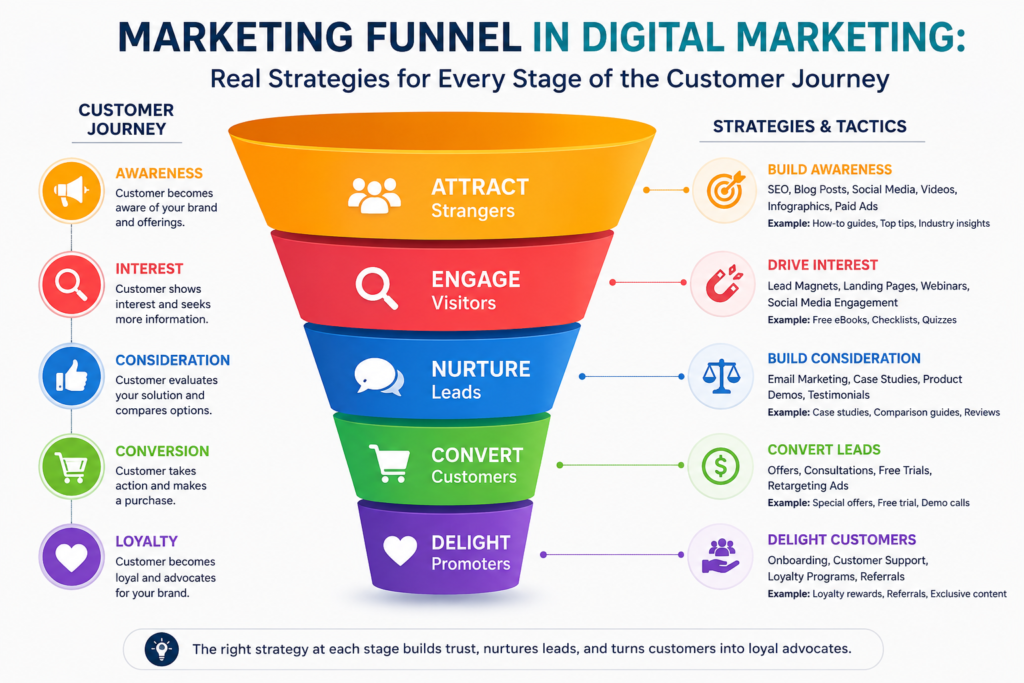
What a Marketing Funnel in Digital Marketing Actually Looks Like in Practice
A funnel on paper appears very straightforward:
Traffic -> Landing Page -> Click on CTA -> Lead Generation -> Qualified Lead -> Purchase
However, every arrow along that path represents a point at which your prospects go silently missing. Most businesses pay attention only to traffic numbers and sales numbers, so they don’t know at which point in between their prospects are disappearing.
The effective digital marketing funnel will do three things exceptionally well:
Speak to the needs of your visitor precisely.
Decrease friction at every step instead of increasing it with extra steps.
Have a follow-through strategy to keep your leads from going missing.
A funnel that fails to do one of those things isn’t doomed – it probably does the other two quite effectively.https://advertising.amazon.com/library/guides/marketing-funnel
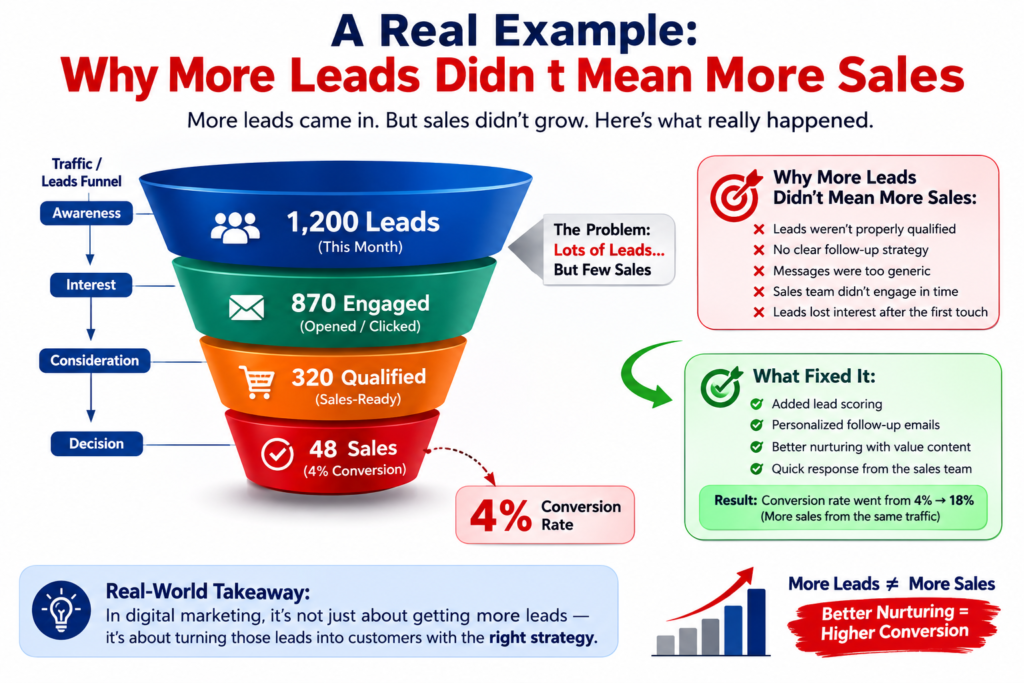
A Real Example: Why More Leads Didn’t Mean More Sales
Here is one project where it is especially obvious. The advertisements were working perfectly — good CTR, steady stream of leads. But not many of those leads resulted in a sale.
As I examined this case further, the following became apparent:
The landing page focused on the company and its offer, not on the visitor’s pain point.
The CTA lacked clarity — visitors weren’t sure what happens after clicking and why to do it now.
New enquiries were followed up inconsistently, sometime even several days later.
What I’ve done:
Focused the offer on one defined customer pain point.
Simplified the design and added trust signals.
Defined a clear and easy-to-perform next step.
Added an immediate follow-up to any new enquiry.
The outcome: no significant change in leads volume, but dramatic increase in conversion rate. No need for extra traffic in the funnel. Need for fixing the leakage between being interested and making a purchase decision.
The key takeaway I can’t get enough of: stop pouring more traffic into a leaking funnel. First, identify the leak and fix it. https://rohithmenon.com/
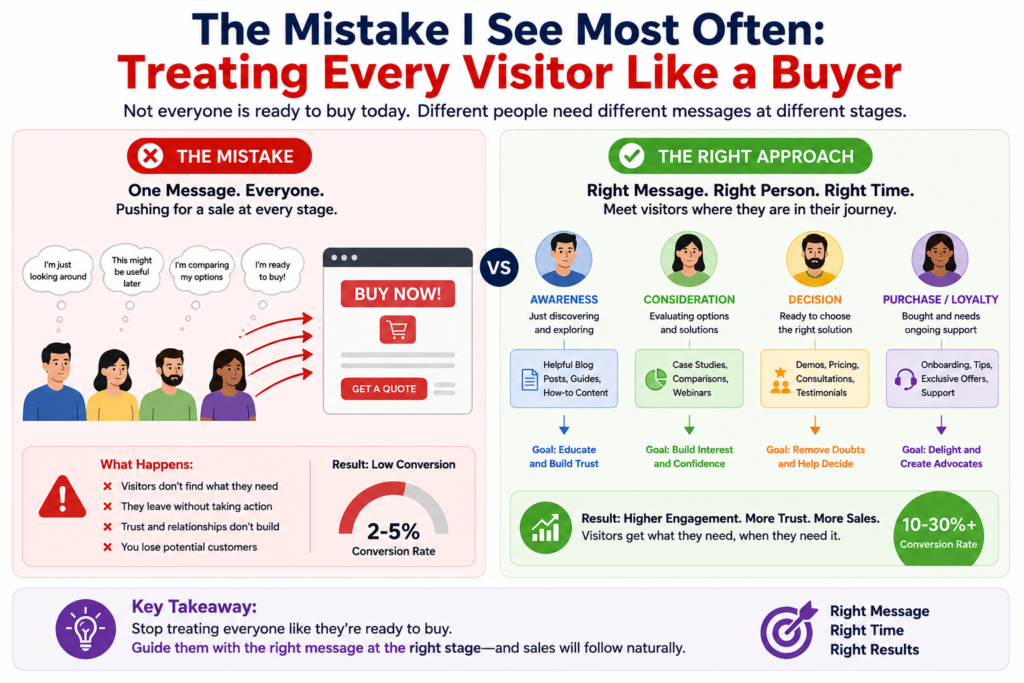
The Mistake I See Most Often: Treating Every Visitor Like a Buyer
A significant number of companies immediately direct cold traffic to a “Buy Now,” “Book a Call,” or “Contact Us” page even though the client still does not have any reason to trust them. This is probably one of the fastest ways to kill the money invested in advertising.
It’s best to design a sales funnel in accordance with the actual stage of the customer’s decision-making process:
Stage
Customer’s Mentality
What The Sales Funnel Must Do
Awareness
Educate the person, build knowledge
Consideration
Build credibility, show evidence
Decision
“I’m ready to make up my mind”
Present an offer, price, call-to-action
Follow-up
“I’m not ready, but I’m interested”
Be visible, add value
A sales funnel shouldn’t force the person to buy something. It should take the appropriate person to the appropriate stage and persuade those who are not yet ready.
The Contrarian Take: Funnels Don’t Need to Be Complicated
This is when my approach differs from the vast majority of expert advice. Whenever conversions are low, the advice is to do more — create more ads, write more content, do more SEO, automate more. However, if the offer is vague and the path to the customer is unclear, additional traffic will lead to the same faulty funnel.
Additionally, there’s a belief that all funnels have to be extremely complex: an automation sequence that involves at least seven touchpoints, a variety of lead magnets, webinars, retargeting stages, and several dozen of emails. For most small and local businesses, such complexity is simply superfluous and could hurt conversions, introducing additional friction.
Sometimes, a simple funnel works better than a complicated one:
Right audience → Clear problem → Strong offer → Proof → Simple next step → Quick follow up
Perhaps the biggest misunderstanding about funnels: you don’t build it and walk away from it. It’s a process which you have to continuously diagnose and adapt based on the actual drop-off places of your prospects — not on the places where you think they leave.
One of my guiding principles: don’t complicate until data says so.
(Not to mention, simplicity and complexity
Frequently Asked Questions
What is a marketing funnel in digital marketing? The process that the potential client goes through in their journey from being discovered by the company to buying something from the company – usually involves awareness, consideration, decision, and follow-up stages.
Why does the funnel leak even if there is good traffic? Mainly because the offer, landing page, CTA, or follow-up is not aligned with the client’s current state of decision-making.
Do small companies need complex funnels? No, not always. Often the simple aligned funnel will be more effective than the complicated one with additional stages.
How do I choose which stage to optimize first? Look at the conversion rate for each stage and find the stage with the largest percentage drop
Key Takeaways
Don’t add additional traffic before making sure that your existing funnel actually converts the traffic you have right now.
Ensure that your offer and call to action fit the buyer’s state of mind – awareness, consideration, decision, or follow up.
Monitor conversion rate between different stages and not top of the funnel to bottom of the funnel.
Tackle the worst problem first, measure its impact, then proceed to the next step.
On-Page SEO Notes
Internal linking opportunity: Link to related posts like “How to Write a Landing Page That Converts” or “Follow-Up Methods That Generate Leads” from the landing page and follow-up section.
External citation: You can cite a relevant authority such as HubSpot research on the conversion rate benchmarks or any other industry study to back up your claim of the conversion rates.
Image suggestion:
Diagram showing the funnel stages (Traffic -> Landing page -> CTA -> Lead form -> Qualified lead -> Sale). “
Before and after image of landing pages.
A diagram showing the stages of awareness/consideration/decision/follow- Video/embed suggestion: A 2-3 minute video explaining the above diagram would be ideal to embed near the “What a Marketing Funnel Looks Like” section.
Schema suggestion: Use Article schema for the overall post, and also use FAQPage schema for the FAQ section to qualify for featured snippets.